
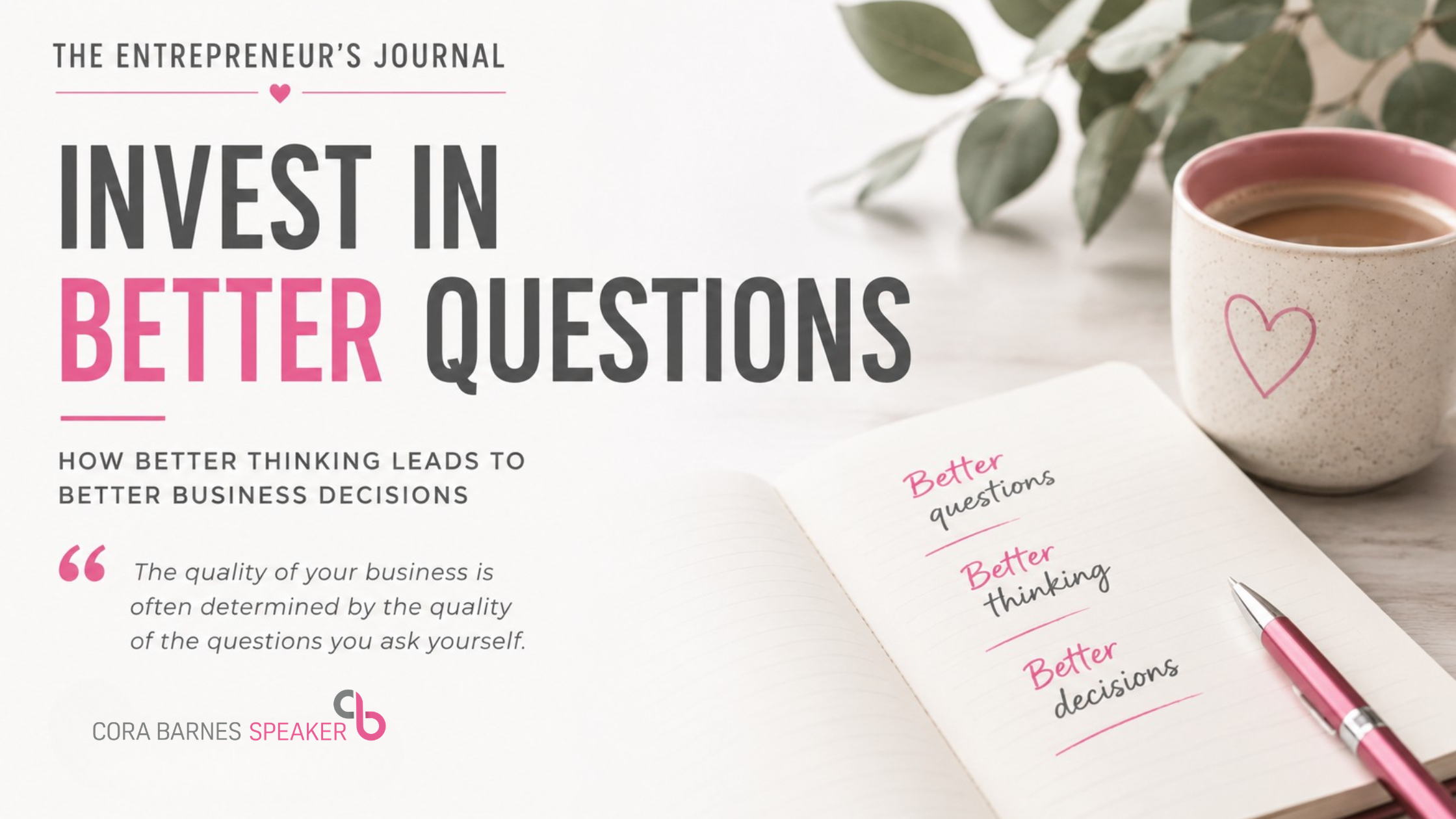
“The quality of your business is often determined by the quality of the questions you ask yourself.”
There are certain lessons in business that stay with you long after you’ve forgotten the model, the theory or the framework. One of mine came during my MBA. It wasn’t about finance. It wasn’t strategy. It was a lecture on leadership and organisational behaviour that was centred around a simple exercise that fundamentally changed the way I think, lead and make decisions. Ten years on from the MBA, I still find myself coming back to it.
Before I tell you about it, though, I’d like to ask you a question.
When faced with an important business decision, how much time do you spend searching for the right answer… compared with asking yourself better questions?
As entrepreneurs, we’re conditioned to believe that leadership means having the answers. We admire decisiveness. We celebrate people who move quickly. We often feel pressure to solve problems immediately because that’s what good leaders are supposed to do.
I’ve come to believe something different. I don’t think the best leaders have all the answers. I think they become exceptionally good at asking better questions.
And in a world where AI can generate answers in seconds, perhaps our greatest competitive advantage isn’t finding answers more quickly, it’s learning to ask questions that lead to better thinking.
Your Brain Isn’t Working Against You
One of the most reassuring things I’ve learned through neuroscience and behavioural psychology is that our brains are brilliantly designed. They’re simply not designed for what entrepreneurship asks of them. Our brains evolved to keep us alive.
They constantly scan for risk, uncertainty and anything unfamiliar. They love patterns, shortcuts and quick decisions because they conserve energy and keep us safe.
Psychologist and Nobel Prize winner Daniel Kahneman described this beautifully in Thinking, Fast and Slow. Much of our thinking happens automatically. Our brains instinctively look for the quickest explanation and the fastest route to a conclusion.
For most situations, that’s incredibly helpful. For entrepreneurship, it can sometimes become a limitation. Because building a business asks us to do something our brains weren’t designed for. It asks us to choose growth despite uncertainty.
When we’re considering a new idea, investing in the business, hiring another employee or changing direction, our first thoughts often sound familiar.
“What if this doesn’t work?”
“Someone else already does this better.”
“We’re too small.”
“It’s too expensive.”
“Maybe next year.”
For years, I interpreted those thoughts as warning signs. Now I see them differently. They’re rarely telling me the idea is wrong. They’re simply reminding me that uncertainty is uncomfortable. There’s an important distinction.
Our brains don’t necessarily resist courage, they resist uncertainty.
And because growth almost always involves uncertainty, it’s easy to mistake discomfort for danger.
Harvard Business Review has written extensively about decision-making and leadership, highlighting that some of the best leaders deliberately slow their thinking before making important decisions. They create space to challenge assumptions, explore different perspectives and become curious before becoming certain.
I’ve found myself doing exactly that. Whenever my immediate reaction is “no”, I now pause and ask a second question.
“Is this genuinely the wrong decision… or is my brain simply trying to keep me comfortable?”
They’re two very different questions. And they often lead to very different answers.
Becoming the Magnus Magnusson of Your Own Business
Some of you will remember Magnus Magnusson, the legendary presenter of Mastermind. He wasn’t famous because he had all the answers. He became famous because he asked the questions.
I’ve often thought that entrepreneurs need to become the Magnus Magnusson of their own businesses.
Not interrogating ourselves harshly. Not constantly questioning our capability. But becoming genuinely curious.
Learning to challenge our assumptions. Learning not to accept the first answer simply because it arrived first.
One decision-making technique I came across suggested something that initially sounded quite strange. When you’re wrestling with an important decision, deliberately dismiss your first answer, not because it’s wrong, but because it’s often incomplete.
Your first answer is usually your brain doing exactly what it was designed to do.
Fast. Efficient. Protective.
Your second and third answers often come after you’ve challenged your assumptions, explored different perspectives and become curious enough to think beyond the obvious.
That’s where better decisions are usually found. Not because you’re suddenly more intelligent. But because you stayed with the question for longer.
One Question That Changed How I Lead
One of the questions I return to time and time again didn’t originate in a boardroom. It came from elite sport.
In the lead-up to the London 2012 Olympic Games, the British Rowing Team became famous for asking one deceptively simple question before making every decision.
“Will it make the boat go faster?”
Everything was measured against that one question.
Would another training session make the boat go faster? Yes.
Would prioritising recovery and getting a good night’s sleep make the boat go faster? Absolutely.
Would staying out late at a barbecue the night before training make the boat go faster? Probably not.
The beauty of the question wasn’t that it made decisions easy.
It made priorities incredibly clear.
I’ve borrowed that principle many times in business.
When we’re reviewing our annual goals, coaching our leadership team or deciding where to invest our time and energy at 3Q Recruitment, I’ll often ask a version of that same question.
“Will this move us closer to the outcome we’re trying to achieve?”
Sometimes the answer is yes. Sometimes it’s no. But often the more valuable conversation becomes:
“Is there something else that would create even greater value?”
That simple shift changes everything. It moves us away from being busy and back towards being purposeful.
Because activity and progress are not the same thing.
Looking Beyond Cost
One example that illustrates this perfectly is payroll.
Like every business, we regularly review how we operate. Running payroll weekly and keeping it entirely in-house comes with a cost. On paper, outsourcing payroll would almost certainly be more efficient.
If I’d only asked one question—
“How can we reduce the cost of payroll?”
—I may well have reached a different conclusion.
But I don’t believe that was the most important question.
Instead, every year we ask ourselves something different.
“Will this strengthen the relationship we have with our temporary employees?”
For us, the answer has consistently been yes.
Our temporary employees know they’ll be paid accurately and on time. If they have a question, they don’t disappear into an anonymous ticketing system or wait days for an email response.
They can speak to someone in 3Q, a real person, someone who answers the phone, someone who knows their name, someone who takes ownership until the issue is resolved.
In recruitment, trust is often built in moments like these. Payroll isn’t simply an administrative process; it’s a relationship.
Every year we review the cost. Every year we review the value. Every year we look at the evidence.
And every year the evidence tells us the same story.
The confidence, trust and loyalty this creates for our temporary employees far outweigh the financial saving we might achieve by doing it differently.
That decision wasn’t driven by cost. It was driven by asking a better question.
Sometimes the cheapest answer isn’t the smartest answer.
Sometimes the question you’re asking determines the business you become.
The Balcony and the Dancefloor
The exercise from my MBA that has stayed with me was called The Balcony and the Dancefloor.
One person stood on the dancefloor and shared a genuine business challenge they were facing. Everyone else stood on the balcony looking down.
The rule: questions only.
No advice. No opinions. No stories about what we would do. No solutions.
The only thing we were allowed to offer was questions.
Questions like:
“What have you already tried?”
“What assumption are you making?”
“What evidence do you have?”
“What aren’t you seeing?”
“If this wasn’t your business, what advice would you give someone else?”
At first, it felt almost impossible. Like many people, I thought helping meant solving.
Surely the quickest way to support someone was to tell them what to do.
But something remarkable happened.
Time after time, the person standing on the dancefloor found their own answer.
Not because somebody gave them a brilliant solution.
Because somebody asked them a better question.
That lesson has stayed with me throughout my career.
Whether I’m coaching my own team at 3Q Recruitment, mentoring entrepreneurs or working with young women through The Shona Project, I come back to that exercise again and again.
People rarely need us to think for them. More often, they need someone to help them think more deeply for themselves.
And I think that’s one of the greatest gifts we can give each other as leaders.
Questions Before Answers
One of the ideas I’ve found myself returning to over the past few years is this:
Questions before answers.
We’ve become incredibly good at searching for answers.
- We Google.
- We listen to podcasts.
- We ask mentors.
- We attend conferences.
- We ask AI.
None of those things are wrong. In fact, I do all of them.
But I’ve started to notice something.
Sometimes we rush to find an answer before we’ve really understood the question.
The quality of our thinking is determined by the quality of the questions we’re willing to sit with.
And sitting with a question takes patience, curiosity and courage because our brains like certainty. They like closure. They’d rather arrive at a quick answer than stay in the discomfort of uncertainty.
Yet that’s often where the best thinking lives.
I’ve learned (the hard way, and forgotten more times than I would like to admit) that my first answer is rarely my best answer; it’s simply my quickest.
My second answer may be a version of my first, but by the third or fourth, I’ve often uncovered something I hadn’t seen at all.
That’s why I’ve become comfortable challenging my own thinking.
Not because I enjoy making decisions harder.
Because I want to make them better.
Questions That Stop You in Your Tracks
Every so often, you hear a question that stays with you.
One of those came from Joanne at Manifest Like Mom. She simply asked:
“What would this look like if it was easy?”
I stopped scrolling.
Not because business is easy—we all know it isn’t—but because I realised how often I complicate things without meaning to.
That one question encourages me to strip away assumptions, remove unnecessary complexity and stop creating obstacles that perhaps don’t exist.
Another question I come back to regularly (from her sharing) is this:
“What am I pretending not to know?”
That one is a little less comfortable.
Usually because somewhere deep down… I already know.
Perhaps I’m avoiding a difficult conversation and holding onto an idea that’s no longer serving me but that is safe and familiar—that old story that is an old story.
Perhaps I’ve already recognised the answer but haven’t yet found the courage to act on it.
The most valuable questions are rarely the easiest ones.
They’re the ones that gently expose the stories we’ve been telling ourselves.
AI Isn’t Replacing My Thinking—It’s Improving It
People often ask me how I use AI. My answer sometimes surprises them.
I don’t use it primarily to give me answers.
I use it to help me ask better questions.
One of my favourite prompts is incredibly simple:
“Don’t solve this problem for me. Ask me five questions that will improve my thinking.”
It changes everything.
Instead of becoming dependent on someone—or something—else’s answer, I’m encouraged to think more deeply myself.
The questions often uncover assumptions I didn’t realise I was making, encourage me to see another perspective, or sometimes reveal that I’ve been trying to solve the wrong problem altogether.
For me, that’s where AI becomes genuinely valuable.
Not as an answer machine.
As a thinking partner.
Six Questions Worth Investing in This Month
The next time you’re planning your week, reviewing your quarterly goals, preparing for an important client meeting or making a significant business decision… pause before you look for the answer.
Start with a better question.
These are six that I come back to regularly.
- What would this look like if it were easy?
- What am I pretending not to know?
- Will this make the boat go faster?
Or in business terms…
- Will this genuinely move us closer to the outcome we’re trying to achieve?
- What assumptions have I accepted without challenging?
- If fear wasn’t making this decision, what might I choose differently?
Don’t rush them.
Write them down. Go for a walk. Have a coffee. Sleep on them. Let the question marinate in your brain.
And then challenge your first answer and write another.
Your best thinking often arrives after your quickest thinking has stepped aside.
Questions Create Better Businesses
I’ve spent many years believing that good leaders were the people with the answers.
Today, I believe something different.
I think the best leaders create better thinking. They create environments where curiosity is welcomed, where we are all empowered to ask questions, where assumptions are challenged respectfully and where people feel safe to ask, “What if?”
And where the quality of the conversation becomes more important than the speed of the decision.
I 100% have to consciously hold myself to account when I “rush it with an answer” rather than share a thought that is still forming (or half-baked, as some would say).
Business has taught me that certainty is often overrated.
Curiosity, on the other hand, compounds—but takes time and patience and sitting in “the space between” rather than firmly being on the next step (even if the next step is just familiar, not right).
Every better question opens another possibility.
Every possibility creates another option.
Every option gives us a greater chance of making a wiser decision.
Perhaps that’s why the businesses that continue to grow aren’t always the ones with the smartest people.
They’re often the ones asking the smartest questions.
Closing Reflection
As entrepreneurs, we sometimes believe we’re expected to have all the answers.
I’ve come to realise that’s not our job at all.
Our stance to hold is to stay curious, to think deeply, challenge our assumptions, and create enough space between our first thought and our final decision that wisdom has a chance to catch up.
So, the next time you’re facing a difficult decision, don’t begin by asking yourself:
“What’s the answer?”
Pause.
Instead ask:
“Am I asking the right question?”
Because better questions don’t simply create better answers. They help to form better leaders, better relationships and better businesses—and perhaps, a better life.
Resources That Have Influenced My Thinking
If you’d like to explore this topic further, these are some of the resources I’ve found particularly thought-provoking:
- Thinking, Fast and Slow – Daniel Kahneman
- Think Again – Adam Grant
- The Coaching Habit – Michael Bungay Stanier
- TED Talk: The Power of Believing That You Can Improve – Carol Dweck
- Harvard Business Review articles on leadership, curiosity and decision-making.
You don’t need to agree with every idea.
But each of them encourages something I believe every entrepreneur should practise.
Thinking more deeply before deciding what to do next.
👠 Put Your Courage Shoes On
This month’s Courage Shoes challenge is a little different.
It isn’t about taking a giant leap.
It isn’t about making a life-changing decision overnight.
It’s about having the courage to stay with a question.
Choose one business challenge you’ve been carrying around.
Instead of trying to solve it immediately, spend twenty minutes writing questions.
Challenge your first answer.
Then challenge the second.
Ask AI to question your thinking rather than solve your problem.
Talk it through with someone who will ask you thoughtful questions instead of giving quick advice.
Give yourself permission to become curious before becoming certain.
Because sometimes courage isn’t found in moving faster.
Sometimes courage is found in slowing down long enough to think differently.
Put on your Courage Shoes.
Ask one better question.
Then take one small step.
You might be surprised where it leads.
Final Reflection
One of the unexpected gifts of entrepreneurship is that it changes the way you think.
I’ve certainly become more resilient, more optimistic, and yet I am still not as comfortable with uncertainty as I believed I would be at this time in my life—but that’s OK for me.
I think that being self-aware and asking good questions builds my curiosity and a Growth Mindset.
I’ve become more curious.
I’ve stopped believing that my value lies in always having the answer.
Instead, I believe my greatest value often comes from asking the question that nobody else has thought to ask.
If this blog encourages you to do one thing this month, I hope it’s this:
Invest in better questions.
Because the return on that investment won’t just shape your next decision.
It will shape the leader, and the person, you continue to become.


